
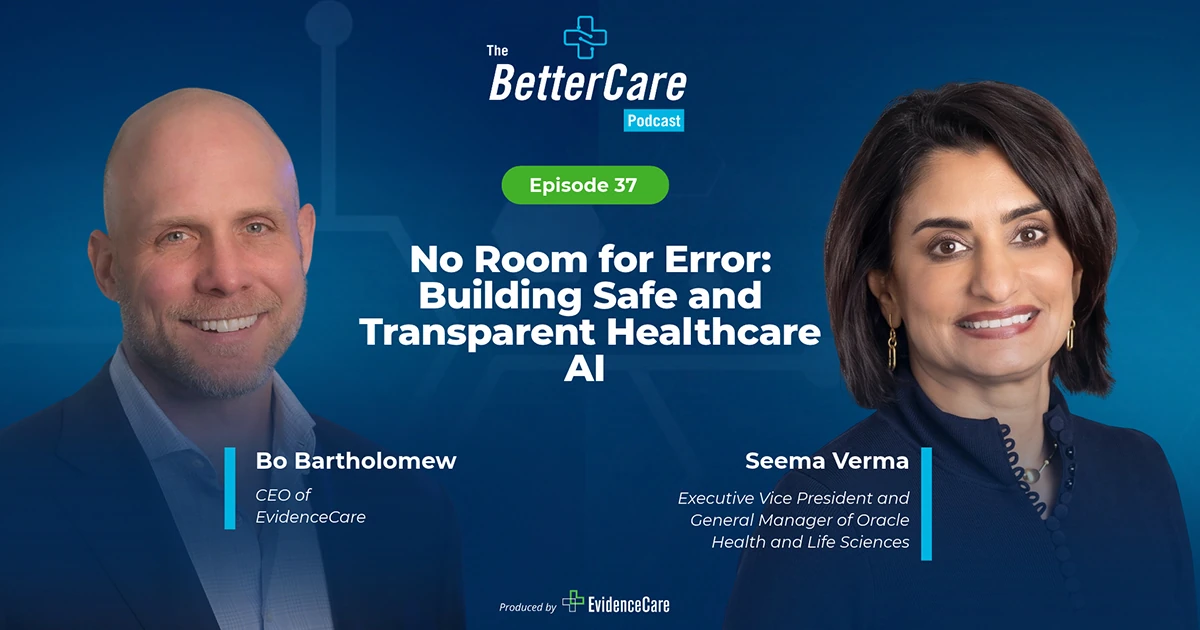
From episode 37 of the BetterCare Podcast, hosted by Bo Bartholomew, CEO and chairman of EvidenceCare.
Seema Verma led the Centers for Medicare and Medicaid Services, overseeing coverage for 145 million beneficiaries, before becoming executive vice president and general manager of Oracle Health and Life Sciences. She sat down with Bo Bartholomew at the Nashville Healthcare Sessions conference to talk about how health system leaders should build a healthcare AI strategy as the pressure to buy grows.
She describes her job the same way across every title she has held: set the strategy, then do the harder part, which is delivering on it. Her advice on AI follows that pattern. Before buying another tool, understand how the technology works, because that understanding should shape every purchase that follows.
A healthcare AI strategy needs a data strategy first
According to Verma, AI is only as good as the data it can reach, and it needs that data in real time and from many systems at once. She compares it to a clinician at the bedside, who weighs the medical literature, what the insurer will pay and what the patient prefers before making a call.
A model can be impressive and still fail at the moment that matters. If it can’t see that a patient has an allergy, or that a scheduled surgery needs prior authorization, the recommendation it makes isn’t safe to act on.
Her conclusion is that a health system can’t build a healthcare AI strategy without a data strategy. The first step is bringing the organization’s data together so that models can reach what clinicians and administrators need. She laid out this argument in more detail in an article for Oracle, Avoid the pitfalls of healthcare AI: What leaders must do differently, which Bo promised listeners he would share.
Why bolt-on tools stop at one task
Generative AI can draft a note. Verma sees the bigger value in agentic AI, which can complete the work itself, and in healthcare a single task usually has many steps.
She uses a denied claim as the example. A coding tool can code the claim. When the claim is denied, appealing it means pulling data from the EHR and other systems, and a bolt-on tool built for coding can’t do that. Finishing the job takes data from the supply chain, the ERP, the EHR and the revenue cycle working together.
Every bolt-on also adds cost on top of the systems a health system already pays for, and it adds cybersecurity exposure. In her experience, AI works best when it is embedded in the core application, where it has the latest data.
Every recommendation needs a why
Verma is direct about the stakes: in healthcare, AI decisions affect people’s lives, so there is no room for error. At Oracle she set out publicly how the company trains its models and how it monitors them once they are live.
She holds clinical AI to four requirements:
- Transparency: the clinician can see why the AI made its recommendation, such as a patient allergy or an insurer’s rules.
- Traceability: the recommendation links back to its source, even a note written three years earlier.
- Monitoring: the model is watched after release to make sure it keeps working to best practice.
- A human in the loop: AI makes the recommendation, and a person makes the final decision.
She also has a view on why AI hallucinates. In many cases the cause is a lack of real-time data rather than the model. An EHR built on a 1990s database was designed as a system of record, not for the kind of retrieval AI depends on. She treats copying data into a separate system to work around that as a warning sign, because every move carries cyber risk and the chance that data doesn’t transfer correctly.
Why governance belongs in every healthcare AI strategy
More tools now let employees build their own AI models. Verma says that makes internal governance essential. Each organization needs to decide who can build models, what data those models can touch, how they are tested before release, and what happens when a clinician disagrees with the AI.
Without those rules, one person could build a model and deploy it across the enterprise before anyone tested it or agreed to it.
What it means for the CIO, the physician and the CFO
Bo summed up the conversation for the different leaders who listen to the podcast:
- CIOs need governance that covers how tools are taken in, audited, overseen and controlled.
- Physicians want to be equipped to make the call, and that depends on transparency and citations, so they can see why a piece of evidence surfaced and catch a hallucination. Bo noted that EvidenceCare has long pushed for citations too.
- CFOs and administrators need a way to track an ROI that is often hard to pin down.
“You’ve got to take a very holistic approach,” Bo said. Verma agreed that a healthcare AI strategy has to answer to all three at once.
How to choose partners for a healthcare AI strategy
With hundreds of technology vendors competing for health systems’ attention, Verma’s first piece of advice is not to underestimate cybersecurity. A health system running 100 different tech solutions has to make sure all 100 have the right guardrails in place.
Her second is flexibility. Health systems need strong core systems, plus a secure platform that lets them build their own models or bring one in when it makes sense, and that delivers a return.
She also expects vendors to show their work: their guidelines, how they think about safety and how they monitor their tools. Looking ahead, she doubts that point solutions doing a single job will last, because AI increasingly has to coordinate across the whole enterprise.
A new neighbor in Nashville
Oracle is building a new campus in Nashville, which Verma describes as a park first, with a building set beside a body of water. She sees Nashville as the country’s healthcare capital, a community where people come together to solve problems. Bo, who was born and raised in Nashville, welcomed Oracle to town, and Verma named her two local favorites: hot chicken and sweet tea.
Listen to the full episode
Hear Seema Verma and Bo Bartholomew’s full conversation about healthcare AI strategy on episode 37 of the BetterCare Podcast. Sign up for email updates to hear about new episodes when they’re released.
Frequently asked questions
Seema Verma is executive vice president and general manager of Oracle Health and Life Sciences. She previously served as Administrator of the Centers for Medicare and Medicaid Services, after being confirmed by the U.S. Senate in 2017.
AI is only as good as the data it can reach. Verma argues that models need real-time access to data from across the organization, including the EHR, ERP, supply chain and revenue cycle, before they can support clinicians and administrators safely.
In Verma’s view, hallucinations often come from a lack of real-time data rather than from the model itself. Systems built on older database architecture weren’t designed for the retrieval AI depends on.
Verma puts cybersecurity first, followed by platform flexibility. She also recommends asking vendors to explain their safety guidelines and how they monitor their tools once they are live.
Seema Verma appears on episode 37 of the BetterCare Podcast, hosted by EvidenceCare CEO Bo Bartholomew.