

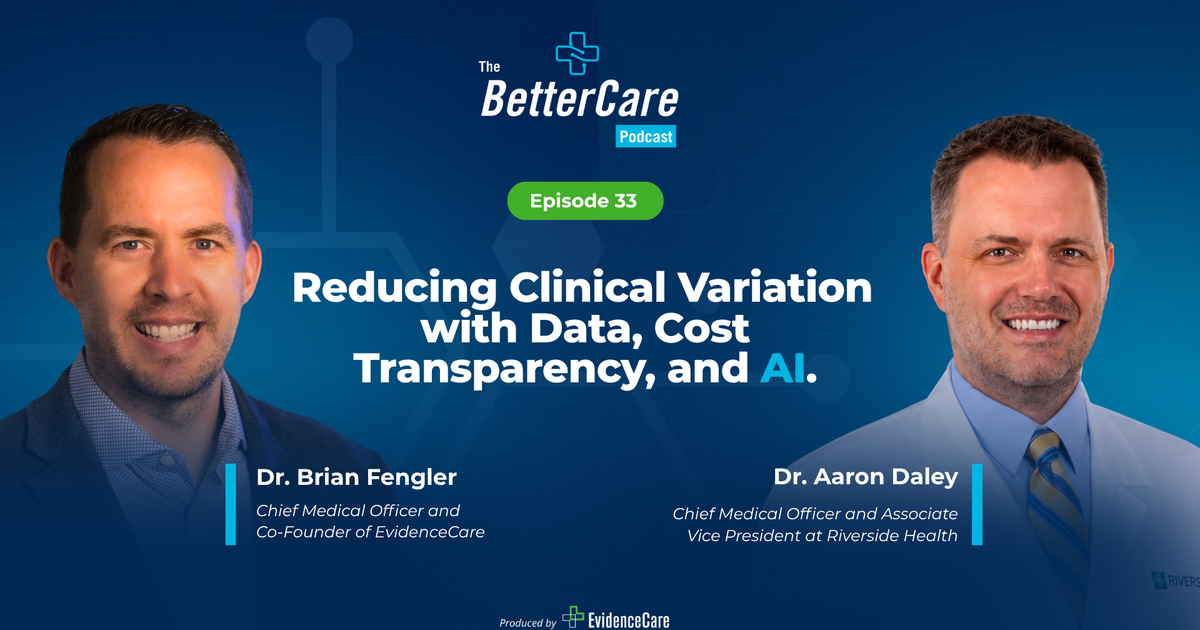
Better Care Podcast | Dr. Aaron Daley, associate chief medical officer, Riverside Health System
Every hospital has physicians ordering the same test for the same diagnosis at meaningfully different rates. The variation is documented. The guidelines exist. The education has been delivered. The variation persists anyway.
Dr. Aaron Daley, associate CMO at Riverside Health System, has a clear-eyed explanation for why. Hospitals aren’t manufacturing plants, where you control the inputs, optimize the process, and expect predictable output. They’re closer to refurbishing plants: you have no idea what’s coming through the door, and the resources you’ll need aren’t knowable until you’re already in the room.
That reframe matters because it changes what “reducing variation” actually means. You’re not trying to engineer a uniform process. You’re trying to get tight on the patterns that are knowable, so you have capacity left over for the ones that aren’t.
Where variation actually comes from
The well-known drivers are real: where a physician trained, when they trained, who taught them. Evidence moves faster than CME schedules allow most clinicians to track, and the continuing education physicians choose to complete reflects personal interest more than organizational need. That’s not a character flaw. It’s the structure of clinical practice.
But Dr. Daley points to a driver that gets less attention. In acute care, variation isn’t only about how a physician treats a condition. It’s about what they believe an acute care hospitalization is for. One physician treats everything they can while the patient is already present. Another focuses on what can only happen in the most expensive care setting in the country, reserving the rest for the ambulatory or virtual setting. Both approaches reflect genuine clinical judgment. The cost and throughput implications are not small.
That question, what actually belongs in the hospital versus somewhere else, is becoming a financial decision as much as a clinical one. Health systems running on thin margins can’t afford to treat the acute care setting as a general-purpose venue for convenience-driven workups.
The data problem
Most clinical and operational leaders know that surfacing physician performance data carries real risk. Show a physician how they compare to peers without the right context, and you get defensiveness, resentment, or both. The data becomes something people find ways to dismiss.
Riverside has been deliberate about this. When they rolled out CareGauge, Dr. Daley and the system CMO were explicit with physicians: this information is not tied to evaluation, compensation, or discipline. It is for your benefit.
That’s not self-executing. Dr. Daley acknowledges it directly. What leadership says and what happens at the service line level don’t always match. Maintaining that integrity requires ongoing attention, not a one-time policy statement. When unblinded peer comparison data gets used informally to single out outliers, it can shift from educational tool to source of shame fast, and the damage to trust is hard to undo.
The counterweight Riverside has used is cost transparency. Physicians weren’t trained to think about what they order in terms of unit cost. The prices change in ways that are genuinely hard to track without real-time data. A medication that was expensive during residency may now be the cheaper option. A generic assumed to be the low-cost choice may have repriced. When physicians see the actual cost attached to their utilization patterns, the conversation changes. It stops feeling like oversight and starts feeling like information they’ve wanted and never had.
What actually changes behavior
The mechanism that has worked at Riverside is the grand rounds, not the performance report. CareGauge data becomes the starting point for a peer discussion, with evidence-based guidelines sitting alongside actual utilization patterns. Dr. Daley describes this as showing physicians the current state of the evidence, not directing their practice.
The guidelines update. Most physicians, carrying full patient loads and choosing CME based on interest, aren’t tracking every update from every relevant professional society. An organized forum where the evidence gets reviewed, where physicians can see how peers are approaching the same scenarios, and where the group can discuss best practice openly is structurally different from a data dashboard landing in an inbox.
The behavior change that tends to follow is grassroots. One physician notices a peer getting better results on a particular diagnosis and asks how. That kind of peer-to-peer exchange is difficult to manufacture from the top down. The data creates the opening; the conversation does the work.
Not every physician will move. Dr. Daley is clear about this. For those whose variation isn’t causing patient harm, some amount of acceptable difference in approach is fine. The realistic goal is shifting the center of the distribution, not converting the outliers.
The HRO principle that hospitals keep relearning
Dr. Daley spent time in nuclear power, submarine duty, and aviation before healthcare. High-reliability organizations across all of those industries deal with the same fundamental challenge: people in complex systems will eventually make errors. You cannot design that out. You can design systems that catch it before it causes harm.
The lesson that transfers: education is necessary but not sufficient. He describes a unit at Riverside with no catheter-associated urinary tract infections in over a decade. The nurses on that unit are obviously educated. But what holds the streak is the surveillance, the processes, and the checks built around the behavior, not the training that preceded them.
Most hospitals still treat quality improvement as primarily an education problem. The data says it isn’t.
A note on AI
The episode closes on the question of AI in clinical practice. Dr. Daley’s take is grounded. Ambient AI has had a real impact on physician retention at Riverside. Physicians describe getting their lives back. The governance concern is familiar: are they reviewing what the AI produces, or accepting it the way clinicians once accepted copied-forward notes?
The larger AI opportunity he points to is in the administrative friction between providers and payers, a process that is people-heavy, checklist-heavy, and expensive in a way that has little to do with patient care. That friction is exactly the kind of problem AI is well suited to address. Getting it right will require the same governance instincts being applied in clinical contexts: human review, clear accountability, and an explicit answer to where the tool ends and the physician’s judgment begins.
Dr. Aaron Daley joined Dr. Brian Fengler on the Better Care Podcast to talk about clinical variation, length of stay, cost transparency, and how Riverside Health has approached physician behavior change without weaponizing data.
Frequently asked questions
Why does clinical variation persist in hospitals?
Clinical variation persists because of when and where physicians trained, the pace at which evidence updates relative to CME schedules, and disagreement about what acute care hospitalization is for. One physician treats everything while a patient is present; another focuses only on what requires the most expensive care setting. Both reflect genuine clinical judgment, but the cost and throughput implications are substantial. Variation also persists because data exists but is rarely delivered in a way that changes behavior.
How do hospitals reduce clinical variation without alienating physicians?
The most effective approach pairs peer comparison data with cost transparency, then delivers both through a clinical forum rather than a performance report. When physicians see utilization patterns alongside evidence-based guidelines and actual unit costs in a grand rounds setting, the conversation shifts from oversight to education. Grassroots behavior change follows when physicians compare approaches with peers rather than responding to top-down mandates.
What causes length of stay variation in hospitals?
Length of stay variation stems from differences in how physicians trained, gaps between current evidence and individual practice, and disagreement about what should be accomplished during an acute care admission versus in outpatient or virtual settings. Overutilization of constrained resources like imaging can create bottlenecks that extend stays for all patients.
What is physician cost transparency in healthcare?
Physician cost transparency means giving clinicians real-time access to the unit cost of tests, medications, and procedures they order. Most physicians were not trained to think about cost, and prices shift in ways that are hard to track without live data. When physicians see actual cost data alongside their utilization patterns, it often changes ordering behavior without administrative mandates.
What is a high-reliability organization (HRO) in healthcare?
A high-reliability organization (HRO) in healthcare is a system designed to minimize harm from human error through process design, surveillance, and built-in checks rather than relying on training alone. The principle, drawn from industries like aviation and nuclear power, holds that in complex systems, errors will occur. The goal is building systems that catch errors before they cause harm, not assuming education will prevent them.