
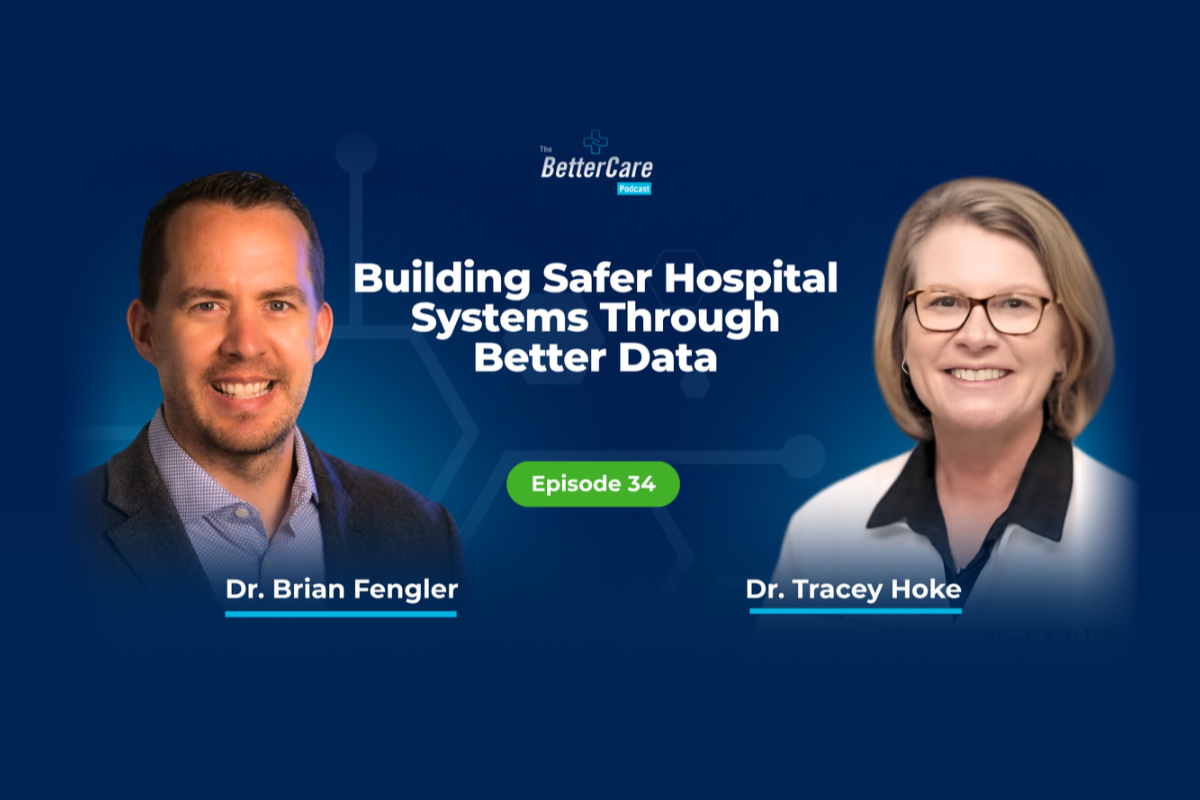
Dr. Tracey Hoke has spent over a decade trying to change how doctors practice medicine, and she’s learned the hard way that showing someone a dashboard almost never works.
Hoke is chief of quality and performance improvement at UVA Health, where she also serves as chief of population health. On a recent episode of the BetterCare Podcast, she walked through what has actually moved the needle on physician behavior during her time in the role, and it wasn’t a new reporting tool or a mandate from the C-suite.
It was a neurosurgery chairman who braced her for an argument and instead thanked her for finally bringing him the data.
Start with the system, not the person
Hoke opens most conversations about quality with a premise that sounds obvious until you sit with it: nobody comes to work planning to cut corners.
“Not one person comes to work in healthcare and says, I’m going to hurt somebody today, or I’m going to cut some corners today, or I’m just not going to do my job today,” she said. “So if you accept that everybody is well trained and well intentioned, then you have to really examine the systems in which they work to see why it is that these systems let them down so often.”
That premise shaped Be Safe, the lean-methodology program UVA built after a new health system executive vice president brought lean principles to the organization. The tools, Hoke says, were the easy part: huddles, root cause problem solving, visual boards that track trends by unit. What took longer was getting leaders to treat those boards as evidence of where their own systems had failed a provider, not as a scorecard for the provider.
The program built a cascading huddle structure that still runs today: a bedside shift-change huddle each morning, a service-line huddle an hour or two later, and a daily 10 a.m. session where the executive vice president shows up in person to hear what got escalated. Hoke says that consistency, showing up every day, is what built the trust to surface real problems instead of polished ones.
One of them: a metal operating table used in spine surgery that was driving pressure injuries in patients whose backs were being operated on. A circulator on the team, not a nurse but the staff member who helps set up the room, floated an idea for a redesigned pad. UVA pulled in an engineer and a materials scientist, tested a new material in the OR, and cut the pressure injury rate in that population by about 40%.
What actually changes a physician’s mind
Hoke’s clearest example of behavior change involves a 40% higher rate of C. diff infection in a neurosurgery ICU population, driven by wide variation in antibiotic prescribing.
She didn’t bring a policy memo. She brought three graphs: the infection rate compared to peer institutions, the prescribing variation by provider, and the published best-practice article on antibiotic use in that population, written by the department chairman she was presenting to.
He crossed his arms, and Hoke braced for pushback. Instead he told her he couldn’t believe she hadn’t brought it to him sooner. The team rebuilt all 60 order sets in the EHR so that physicians couldn’t select anything except the best-practice option, and the infection rate dropped into best in class among peer institutions.
Hoke’s rule for herself before she brings a problem to a physician: she needs to know it’s hurting patients, she needs to know it’s a real pain point for providers, and she needs to know there’s a best practice being missed. Absent all three, she doesn’t ask a physician to change.
The other piece is how the data itself gets handled. Hoke shares outcomes unblinded, by name, and she’s spent years building the credibility to do that without triggering defensiveness. Her approach: show the physician exactly how the data was attributed to them before showing them the number, and be willing to admit when an attribution turns out to be wrong. Physicians who see that process enough times stop arguing about methodology and start engaging with the actual finding.
Ratings and benchmarks are not the same thing as truth
Every hospital lives inside a stack of external rating programs: CMS Star Ratings, Leapfrog, U.S. News, HEDIS measures, and dozens of payer-specific scorecards. Across UVA’s data portals, roughly 10,000 metrics exist between those external programs, internal clinical registries, and local tracking. Hoke’s team narrows that down to 10 to 20 priorities a year, chosen for where a real best practice exists and where that practice shows up across multiple external benchmarks at once.
Her caution: a hospital can be rated well on a metric in one benchmark and poorly on the exact same population in another, because the data sources, time windows, risk adjustment models, and peer groups behind each rating are all different. Before she brings any external rating to her board, she says, she brings her own read of how that rating was built, not the rating’s headline number.
One example she raised directly: sepsis management metrics tied to lab draw timing are still built around a clinical standard her own ICU physicians consider outdated. Rather than chase the metric for the sake of the score, her team documented why they disagree and moved on to measures they believe actually reflect patient care.
That distinction matters because ratings carry real financial weight. Hoke described the exact case she makes to hospital boards when a quality investment doesn’t have a clean revenue return: it may still move a Leapfrog grade or a payer’s quality-based reimbursement tier, and that’s a legitimate value even when it isn’t a line item.
Where this leaves the next few years
Hoke’s read on the near-term future of quality work is less about new technology than most people expect. Hand hygiene, infection prevention, and face-to-face communication between the most experienced people on a care team, not the least experienced, are still where she sees the biggest gaps.
AI, in her view, is genuinely useful for spotting patterns across large data sets faster than a person can. But she’s clear that it doesn’t replace the trust-building work of showing a physician their own data and standing behind it. That’s the same principle behind EvidenceCare’s CareInsights, which delivers peer-comparison data to physicians directly rather than asking them to go find it in a dashboard.
Listen to the full conversation with Dr. Tracey Hoke on the BetterCare Podcast for more on the Be Safe program, how UVA structures its daily huddles, and her advice for chief quality officers just starting out.
Frequently asked questions
What is the Be Safe initiative at UVA Health?
Be Safe is a lean-methodology quality program UVA Health built after a new health system executive brought lean principles to the organization. It combines daily huddles, root cause problem solving, and visual performance tracking to surface system failures that lead to patient harm, rather than treating those failures as individual provider error.
Why do hospital quality ratings like Leapfrog and CMS Star Ratings sometimes conflict with each other?
Each rating program uses different data sources, time periods, peer comparison groups, and risk adjustment methods. A hospital can score well on one benchmark and poorly on another for the same patient population and the same underlying data, which is why quality leaders need to interpret a rating’s methodology before acting on the score.
How do hospitals change physician behavior around clinical variation?
According to Dr. Tracey Hoke, physicians respond to data that clearly connects a patient outcome to a specific, unaligned practice pattern and a documented best practice. Sharing that data unblinded, with clear attribution the physician can verify, builds the trust needed for lasting change.
What role does AI play in hospital quality improvement?
AI can identify patterns across large clinical data sets faster than manual review. Dr. Hoke’s view is that it should support, not replace, the human relationship between quality leaders and physicians that makes data-driven change stick.