
Leading a safety-net hospital means navigating a unique tension: serving everyone who walks through your doors, regardless of their ability to pay, while maintaining the operational discipline needed to keep those doors open. It’s mission-driven work that requires clinical excellence, financial pragmatism, and a genuine commitment to meeting patients where they are—not just medically, but socially and economically.
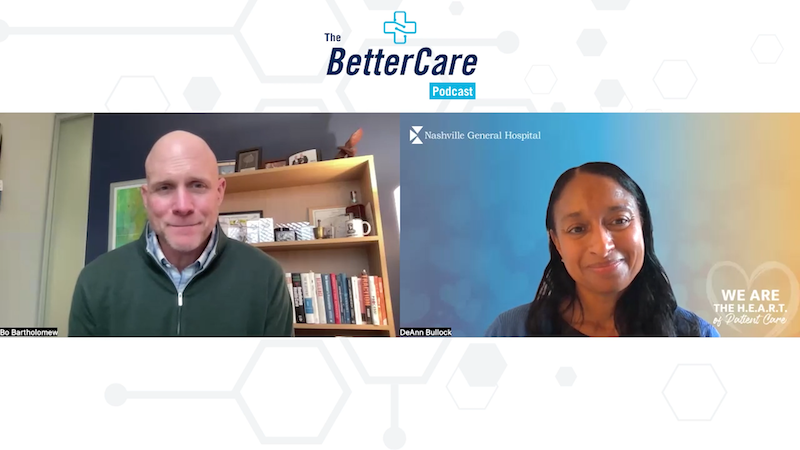
In a recent episode of The BetterCare Podcast, EvidenceCare CEO Bo Bartholomew sat down with Dr. DeAnn Bullock, Chief Medical Officer at Nashville General Hospital, to discuss how she and her team balance these priorities every day.
Dr. Bullock wears three hats—CMO, Emergency Department Medical Director, and Medical Director for the Sexual Assault Nurse Examiner (SANE) program—and brings nearly two decades of experience serving Nashville’s most vulnerable populations.
What emerged from the conversation wasn’t just a story about safety-net care. It was a practical blueprint for how any health system can build equitable programs, improve clinician workflows, and simplify an overly complicated system for patients and providers alike.
Some quotes have been lightly edited for clarity and brevity.
Ep 32 – Delivering Care Where It’s Needed Most – Dr. DeAnn Bullock (Nashville General Hospital)
From emergency medicine to hospital-wide leadership
Dr. Bullock’s path to the CMO role started in a place that teaches you to say yes first and figure out the details later: the emergency department.
“Everything rolls down to the ED. Everything comes through the front door,” she explained. “It’s a 24/7 job. It doesn’t close, and so when people need things done, they call on the ED.”
That experience—managing constant demands, supporting teams under pressure, and solving problems in real time—became the foundation of her leadership philosophy.
When Nashville General needed a full-time CMO, Dr. Bullock had already spent years building trust across the organization. She’d served as quality director, then ED medical director for over a decade. She understood the hospital’s patients, its clinical teams, and its community role.
And then COVID hit less than a year into her CMO tenure.
“Really just kinda jumped in the fire and kept it moving,” she said matter-of-factly.
That willingness to step into challenges, combined with deep operational knowledge, has made her an effective bridge between frontline clinicians and executive leadership.
What equitable care looks like in practice
Nashville General’s mission is straightforward: To improve the health and wellness of Nashville by providing equitable access to coordinated patient-centered care, supporting tomorrow’s caregivers, and translating science into clinical practice.
But living that mission requires more than clinical care. It means addressing the full spectrum of patient needs—from transportation and food insecurity to insurance navigation and medication access.
When Dr. Bullock answered what equitable care means at Nashville General, her answer was concrete:
“Equitable care in our space means that everybody has access to the resource in which they need, however they need care. And that’s different for everybody.”
Nashville General has built an ecosystem of support services that go far beyond traditional hospital offerings:
Transportation: A donated van (“the CHAD van”) originally intended for oncology patients now serves anyone who needs a ride to appointments, helping reduce no-show rates across the board.
Food pharmacy: Patients can shop for food based on their medical conditions, working with dietitians to select items for diabetic diets, oncology nutrition needs, or other health requirements.
Meds-to-beds: Upon discharge, medications are brought directly to patients’ bedsides—no trip to the pharmacy required.
Clothing closet: Staff keep jackets, socks, and cold-weather gear on hand for patients who need them.
Community care team: A multidisciplinary team of case managers, social workers, and nurse practitioners provides ongoing support for patients with chronic conditions or frequent ED visits, checking in weekly to ensure they have medications, understand how to take them, and can get to follow-up appointments.
What was most striking about these programs is that they weren’t designed because of a new payment model or external mandate. They exist because the team recognized gaps and filled them.
“We’ve never done it for payment,” Dr. Bullock said. “People, whether they have everything they need, don’t have everything they need… people want to be heard, understood, and really want to know that somebody is there to help them.”
Building foundational service lines and community partnerships
Safety-net hospitals face a unique operational challenge: unlimited demand meets limited resources.
Dr. Bullock described it plainly: “We are a city safety-net hospital, and our goal is to take care of every Nashvillian no matter what their ability to pay is. And so with that, we aren’t a for-profit system. We do have some limitations around budgeting.”
The strategy? Focus on foundational services that a general hospital needs to provide, ensure those services are appropriately staffed with committed clinicians, and build community partnerships for everything else.
“We really try to build the foundation of those service lines so that we can keep as many people within our system that we can,” she explained.
For services Nashville General can’t provide directly, partnerships with other health systems become critical. The goal isn’t just to transfer patients out—it’s to ensure they feel welcomed at the receiving facility and can return to Nashville General when appropriate.
Listening first: How to improve workflows without adding burden
One of the themes consistently voiced by Dr. Bullock was the importance of listening to clinicians before implementing changes.
“You have to talk to the clinicians. You can’t assume what they need,” she said. “I spend a lot of time with my clinicians in our organization. What do you need? What are the challenges? How can we make this better?”
This approach isn’t just good leadership—it’s practical. Clinicians hear directly from patients about gaps in the system: phone lines that don’t work, referrals that fall through, prescriptions that can’t be filled.
“When they come back to tell you that, you’ve got to be able to prioritize and listen and say, okay. I’m hearing this four or five times. What’s the challenge?”
The EMR consolidation story
About a year ago, Nashville General completed a major EMR transition, moving from separate systems for clinics and the hospital to a single platform (Oracle/Cerner Community Works).
The goal was to eliminate fragmentation and improve care coordination.
“Our EMR was a huge obstacle to us being able to really navigate between our different places of care for our patients. We had our clinics on one, our hospital on another. Things weren’t talking to each other.”
The results have been significant:
-
- Clinicians can complete notes more efficiently
- Care teams can review complete patient histories across settings
- Orders can be placed and appointments scheduled before patients leave
- Communication with other health systems improved dramatically
“The workflow of the clinician is better. They’re able to get their notes done easier. We can send notes to other places. They can now read through and figure out what was happening. You know, we can put in orders and have an appointment made before the patient leaves.”
Of course, no EHR implementation is perfect. There are still challenges with specific workflows and integrations. But Dr. Bullock’s team addresses these through ongoing collaboration between IT and clinical staff, building order sets tailored to specific service lines and units.
The CMO role: Listening, mediating, and seeing the whole system
When Dr. Bullock was asked what she wishes more CEOs understood about the CMO role, her answer centered on flexibility, patience, and the unique position CMOs occupy in a health system.
“The chief medical officer role is different everywhere you go,” she acknowledged. “But I think at the end of the day, from a clinician standpoint, your clinicians are looking to your CMO for the clinical support that they need in doing their job appropriately.”
The CMO must navigate both sides: serving as part of the administrative leadership team while also being the clinicians’ advocate.
“Listen first, speak last, say the least amount of words. You’ll come out with the most information.” – Dr. DeAnn Bullock
This philosophy guides how Dr. Bullock approaches problem-solving. Sometimes she’s asked to solve a problem immediately. But often, the best solution emerges when she creates space for people to talk through challenges together.
The CMO also sees the organization from a systems perspective that individual departments or units can’t always access.
“I think one of the big parts of what I do is seeing it from a higher level, but also a whole hospital perspective. How does it affect everybody? How does this downstream effect everybody, not just my department or my unit?”
Looking ahead, Dr. Bullock’s priorities center on strengthening core service lines with committed clinicians, deepening partnerships with Meharry Medical College (where Nashville General serves as the primary teaching hospital), expanding community partnerships with other health systems, and changing external perceptions of Nashville General.
Advice for emerging physician leaders
For physicians considering leadership roles, Dr. Bullock offered straightforward guidance: keep an open mind to unexpected opportunities, be a continuous learner, and think about the bigger picture.
“Sometimes we don’t see kind of the forks in the road, and sometimes those forks in a road can open brand new doors. So what I say to that is if you have the capacity and you have the ability and there’s any interest, say yes.”
On the constant learning required: “Every single day is a new day for me. Every single day, I learn something. I think that’s one of the things I actually love about this role is that there’s always something that comes across your plate.”
And on the mindset shift leadership requires: “Part of leadership too is that you sacrifice a lot. You do the work and you do the good. All the rest of it will come.”
The magic wand question: Make healthcare simpler
When asked what she’d fix in healthcare if she could wave a magic wand, Dr. Bullock’s answer was immediate: “I think we just have to make it less complicated. It’s too complicated for the patients. It’s too complicated for the providers.”
She pointed to the maze of insurance plans, formulary changes, prior authorizations, and coverage gaps that patients—and clinicians—must navigate daily. The problem affects everyone, but it’s particularly acute for patients transitioning to Medicare who suddenly face multiple plan options and coverage decisions.
“There’s a huge opportunity to make this simpler for the patients. It’s just really hard for them, and we’re not really winning any battles by making it harder for them each and every day.” – Dr. DeAnn Bullock
Key takeaways for health system leaders
The conversation with Dr. Bullock surfaced three critical lessons for healthcare leaders:
Programs that address social determinants of health aren’t “nice to have”—they’re essential to clinical outcomes. Nashville General’s holistic approach recognizes that medical treatment is only part of the equation. Transportation, food access, and medication affordability directly impact clinical success.
Listening to clinicians before implementing changes avoids wasted effort. Too many health systems roll out initiatives designed in conference rooms without input from the people who will actually use them. Dr. Bullock’s approach—spending time with clinical teams, prioritizing based on recurring feedback, and involving IT in workflow design—produces solutions that stick.
Safety-net hospitals deserve more recognition and support. These organizations serve as the backstop for the healthcare system, caring for patients others can’t or won’t see. They do it with limited resources, complex patient populations, and financial constraints that would sink many for-profit systems.
Great leaders make the complex simple. That applies to strategy, to operations, and to patient experience. Dr. Bullock and her team at Nashville General are doing that work every day—simplifying care access for vulnerable populations, streamlining workflows for busy clinicians, and building partnerships that strengthen the entire Nashville healthcare community.
Listen to the full conversation with Dr. DeAnn Bullock on Episode 32 of The BetterCare Podcast to hear more about her leadership journey, safety-net operations, and practical strategies for building equitable care programs.