
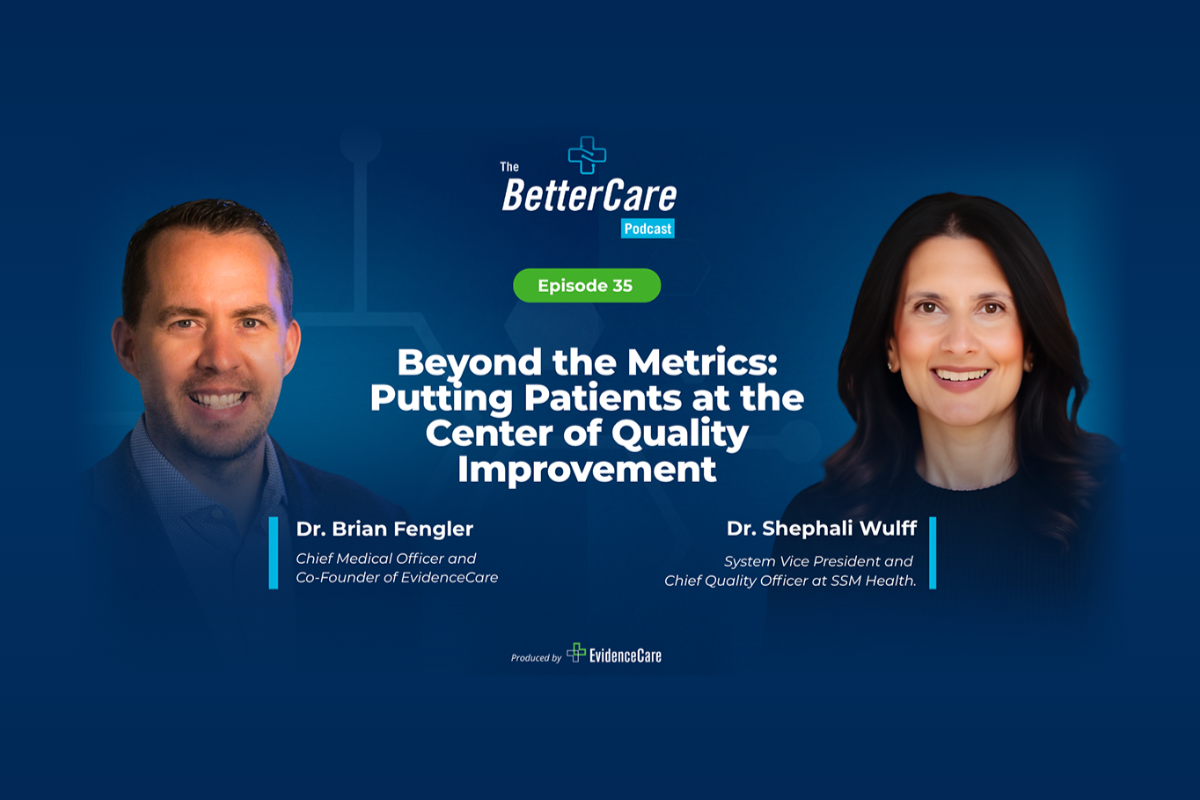
An interview from The BetterCare Podcast, hosted by Dr. Brian Fengler
“These measures are supposed to be goalposts. How are we doing and where can we improve? They’re supposed to be units of learning, not things that we chase to win.”
That’s how Dr. Shephali Wulff, system vice president and chief quality officer at SSM Health, describes her philosophy on quality metrics. Wulff joined Dr. Brian Fengler on the BetterCare Podcast to talk about her path from infectious disease physician to health system leader, and to walk through what happened when SSM Health’s physicians started getting their own practice data in close to real time.
From infectious disease doctor to chief quality officer
Wulff’s path into leadership started at the beginning of the COVID pandemic, when SSM Health asked her to help the system navigate it. She built a team spanning infection preventionists, pharmacists, and microbiology, coordinating decisions on treatment protocols, testing, and isolation across the system. As the pandemic shifted toward endemic management, the team stayed together and turned its focus to hospital-acquired infection prevention. About a year and a half later, SSM’s chief clinical officer asked her to step into the chief quality officer role permanently.
Today Wulff oversees regulatory and accreditation, infection prevention, quality assurance and improvement, employee health, and the infectious disease clinical program: roughly 155 people across 24 hospitals.
The gap between dashboards and behavior
Wulff’s team partners with EvidenceCare on CareInsights, which delivers physicians their own practice data directly, rather than asking them to log into a dashboard. Wulff describes the problem CareInsights solves plainly: most health systems already have dashboards and reports, but physicians don’t log in or engage with them, and when they do, there are often 20 different graphs competing for attention.
CareInsights instead sends one metric a week by text message. Wulff sees this as a difference between data that exists and data that changes behavior. Getting physicians their own individualized practice data, in something closer to real time than most systems can offer, is what turns a dashboard into a decision.
What moved, and how
SSM Health and EvidenceCare built several CareInsights metrics together, with SSM’s clinical leaders helping design them and engaging their own physicians on the results.
Sepsis. SSM had already broken apart the standard SEP-1 bundle to focus on the two drivers Wulff’s team identified as most important: early source control identification and appropriate antibiotics. Since most patients who left SSM with a sepsis diagnosis had come in through the emergency department, the team started there, establishing a clinical time-zero standard and targeting a faster door-to-antibiotic window. After tracking sepsis order set utilization and door-to-antibiotic time through CareInsights, SSM saw meaningful gains on both measures, with several facilities reaching strong utilization rates.
Daily labs. Reducing unnecessary daily labs, like CMPs and CBCs ordered out of habit rather than clinical need, produced a measurable drop in both categories. Wulff is clear that the win here wasn’t about cost. The savings from fewer lab draws are marginal. What moved physicians was reframing the conversation around what a 4 a.m. needle stick means for a sleeping, recovering patient: disrupted rest, unnecessary blood loss, and phlebitis risk for labs that often don’t change management when results have already been stable for days.
Delirium. A hospitalist-led initiative built an order set covering therapeutic recommendations, mobilization, and patient orientation to reduce delirium, which increases risk for falls, aspiration, pressure injuries, and longer stays. Since launch, SSM has seen order set use climb well beyond what baseline behavior would have predicted.
Respiratory viral panels. Not every metric moved, and Wulff is candid about why. The team tried to build diagnostic stewardship guardrails around a costly respiratory pathogen panel, hoping physicians would rely on a cheaper three-test panel for lower-acuity patients. Utilization stayed flat. Wulff’s read: the metric was framed as a cost-savings measure, and cost isn’t a compelling reason for a physician deciding what a specific patient in front of them needs. The next iteration will narrow the target population to urgent care and ED patients being discharged home, where the case for a cheaper, faster test is clinically sound rather than just cheaper.
Metrics as goalposts, not games
Wulff’s clearest example of what she means by “units of learning, not things to chase” involves C. diff testing. SSM uses a two-step testing algorithm, and reporting requirements are based on the last test in that sequence. A group within the organization proposed running the less sensitive test last, specifically because it would produce fewer reportable infections. Wulff’s team rejected the approach because it wasn’t right for patients or for cost, even though it would have improved the reported number.
SSM organizes its roughly 1,400 tracked metrics into five acute-care buckets, mortality, safety, readmissions, length of stay, and experience, plus population health buckets on the medical group side. Wulff’s team is working to find the clinical through-lines that move several buckets at once. A well-designed heart failure pathway, for example, can improve readmissions, length of stay, experience, and mortality simultaneously, because heart failure is SSM’s leading driver of readmissions.
Making the case for a quality program under margin pressure
Asked how she defends her team’s value to administrators watching headcount, Wulff points to three things: the growing complexity of regulatory and reporting requirements, which physicians don’t have time to track themselves; the shift toward value-based payment, where payers and increasingly savvy consumers want proof of safe, effective, efficient care; and the direct financial case, since a strong quality program avoids penalties and helps bring in value-based payment dollars that offset the team’s own cost.
Advice for a new chief quality officer
Wulff’s advice to someone stepping into the role for the first time: listen first. Talk to people across the organization about what quality means to them and where they see gaps. Engage the clinical community directly, since physicians and nurses are the ones who actually drive outcomes. And focus on process measures physicians can influence, rather than outcome measures too far removed from their daily decisions to feel actionable.
Listen to the full conversation with Dr. Shephali Wulff on the BetterCare Podcast.
Frequently asked questions
Why don’t physicians engage with hospital quality dashboards? Most health systems already have dashboards, reports, and recurring meetings built around quality data, but physicians rarely log in or engage with them. A dashboard with 20 competing metrics doesn’t tell a physician what matters or what to do next. Delivering one specific, individualized metric at a time, in a format physicians already check, closes that gap.
Should hospitals treat CMS Stars, Leapfrog, and similar ratings as the goal? Wulff’s approach treats these ratings as goalposts and learning tools, not targets to optimize directly. Her team focuses on delivering the best possible care first, on the belief that ratings improve as a result, rather than designing care or testing protocols around what would produce a better-looking number.
How do you get physicians to change behavior on a quality metric? Framing matters as much as the data itself. SSM found that reframing a daily-labs reduction initiative around patient experience and safety, rather than cost savings, was what actually drove physician behavior. A metric framed purely around cost gave physicians little reason to change what they were doing for the patient in front of them.